What the Map Cannot Hold
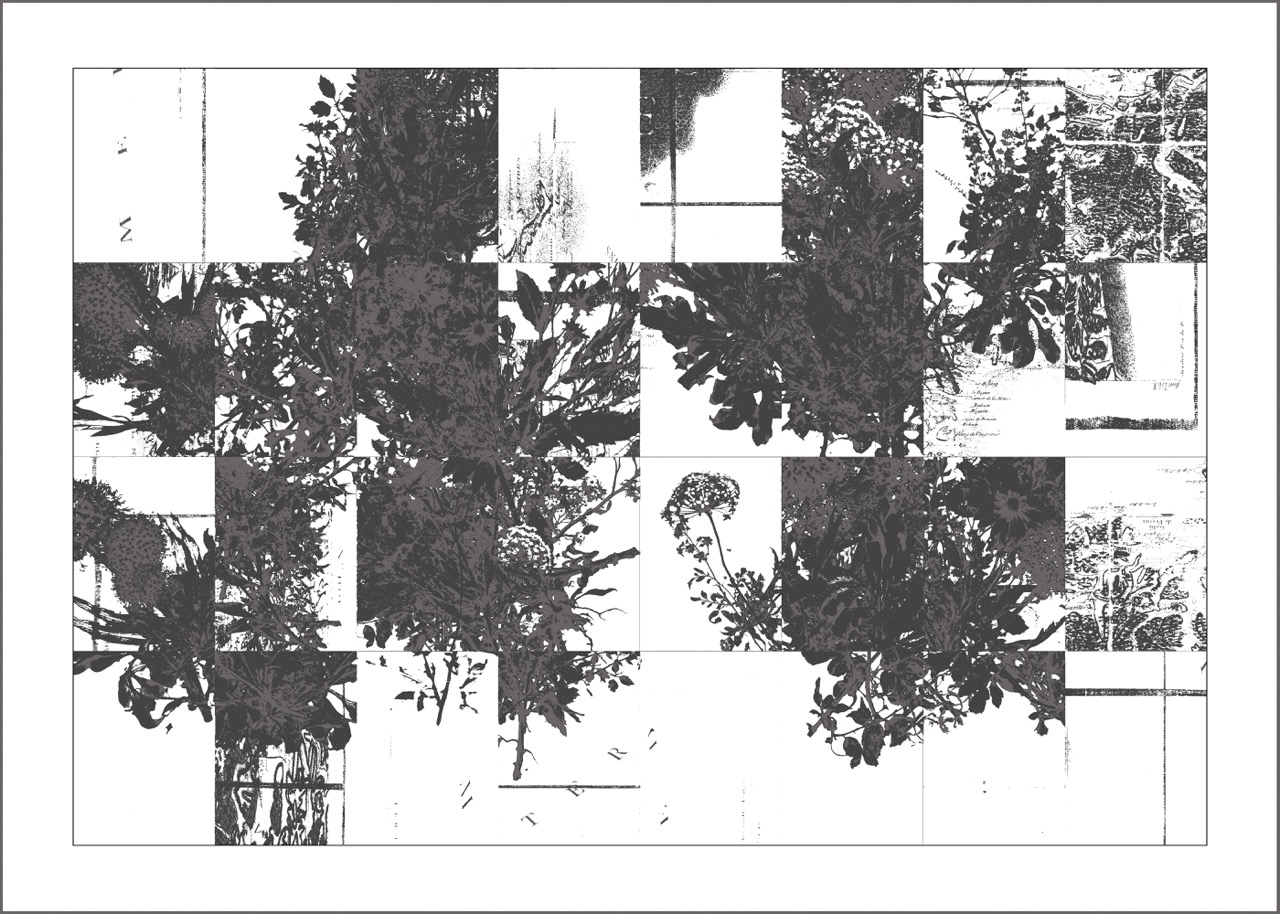
Historical plants from Cannes spread algorithmically across a fragmented Cassini map, escaping the systems created to classify and contain them.
About the work
What the Map Cannot Hold begins with Cassini’s 1780 map of Cannes and Antibes, drawn at the eastern edge of the French kingdom. The map establishes a political boundary, but plants do not recognise the borders used to organise human territory.
The work draws upon historical herbarium specimens collected in Cannes: Picridium vulgare, Allium roseum, Allium neapolitanum, Allium nigrum and Melilotus elegans. Removed from the landscape, dried and classified, these plants constitute a second system for recording the same territory.
The map is reconstructed as a chessboard collage divided into the twenty-one original sections used to fold and transport historical Cassini maps. The herbarium species are distributed across this fragmented territory through a generative reproduction algorithm inspired by cellular automata such as Conway’s Game of Life. The resulting plants are drawn by a plotter, crossing the divisions of the collage and extending beyond the map’s boundary.
The work explores what escapes systems of representation: growth, decay, matter and a living territory that refuses to remain inside the map.
A plotter translates this computational growth into physical lines. The plants spread across the sections of the map, crossing both the boundaries drawn by Cassini and the material divisions of the collage.
Although the machine follows a precise set of coordinates, the different papers absorb the ink differently. Lines change, break or disappear as they encounter variations in colour and texture. The material world begins to resist the systems designed to describe it.
The map measures the territory. The herbarium classifies its living forms. The algorithm simulates their reproduction. The paper introduces uncertainty into all three systems.
At the edge of the mapped territory, nature continues.
The work does not attempt to reconstruct a historical landscape. Instead, it exposes the distance between a place and its representation, asking what remains outside every map, archive, algorithm and system of classification.
Enquire about this work
On 6 April, at the close of the inaugural Classic Cello International Competition in London, a 14-year-old Korean cellist named Jung A Kim walked onto the stage at the Royal College of Music and received a prize that no competition had ever offered before.
€50,000. And the loan of an 18th-century Italian cello worth half a million dollars.
Jung A Kim is, in Nathan’s own words, “one of the most amazing talents I have ever heard.” The cello she received, crafted circa 1770 and believed to have been commissioned by the Medici, will be hers for a minimum of two years, maintained and insured throughout her tenure by world-renowned luthier Florian Leonhard MBE.
Nathan, who was himself the youngest Principal Cello of the Sydney Symphony Orchestra at 19, has spent more than 40 years with this instrument. Hearing it pass to Jung A Kim, he said simply:
“It is in great hands.”
This is what OCTARR was built for.
Become a co-owner
If you’d like to be part of this, shares are still available.
100 tokenised shares at €3,770 each. Co-owners receive a 1/1 signed photographic print of the cello, produced on our proprietary handmade paper crafted from 350-year-old French oak, as well as access to private concerts and priority in future OCTARR projects. Shares are freely transferable.
The 350-year-old “Arbre Remarquable” French oak from the Forêt d’Écouves, planted by order of the Sun King, Louis XIV, and which we have named Dara, will officially launch later this year, in October in London.
Her first children are equally remarkable: beautiful pre-industrial, non-chemically treated, handmade sheets of 50 x 70 cm paper from the brilliant and creative papetier Frédéric Gironde of Ruscombe Paper Mill in Bordeaux.
Her first grandchild was unveiled at a private dinner at the Kunstmuseum, which houses the world’s oldest public art collection, dating back to the same time as Dara herself.
Harto and the Sigg Art Foundation
The Sigg Art Foundation, a wonderful initiative by the Swiss entrepreneur and philanthropist Pierre Sigg, aided by his daughter Maurine, supports and promotes a number of cutting-edge artists. One of them is the Barcelona-based Harto, with whom OCTARR is developing a close and deep working relationship.
On a night which also unveiled a massive sculpture by someone extremely well known, but who must for the time being remain a secret, Harto presented the first work in a ten-work series, Memoria Viva, entitled Latent Memory.
It is printed on OCTARR’s Dara paper.
The concert itself was an all-French affair, drawn from the late 19th and early 20th centuries: a repertoire as demanding as it is luminous.
We open with Maurice Ravel’s Tzigane (Gypsy), written a century ago for the great female violin virtuoso Jelly d’Aranyi, and fiendishly difficult. Transposed to cello, it edges toward the unplayable. And yet Jung A Kim, our pocket-rocket prodigy, plays it as though it were written for her all along.
This first excerpt puts the spotlight on the cello’s G string. On a violin, the G is the lowest string in the instrument’s register. But the cello goes deeper: a C string, tuned a fifth below the G. In fact, every string on the cello sits a full octave below its violin counterpart, which is precisely why hearing Tzigane reborn down here, in this deeper register, feels like meeting an old piece for the first time.
In 1669, Colbert designed a French silviculture system to reorganise and improve French forestry, especially oak for the navy: a programme so patient it is still shaping forests today. The Chêne de Morat, one of France’s protected “Arbres Remarquables”, was one of those trees, left standing for over three centuries so the French National Forestry Office could study how oaks behave over time.
When it was reaching the end of its life, Jean-Luc bought it, and did something that had never been done before: he made wine barrels from a single, almost four-centuries-old tree.
“A 350-year-old oak doesn’t just look different. It ages wine differently.”
Softer tannins, a silkier texture, and aromas no younger tree can produce.
Where our own project begins
OCTARR’s O.A.K. Projects take the roughly 80% of a felled Arbre Remarquable that the cooperage industry can’t use, and turn it into handmade paper and artworks, starting with a tree named Dara.
The goal: give these ancient oaks another 300 years of life. It’s this paper that DARArtNouveau in Brussels is built around.